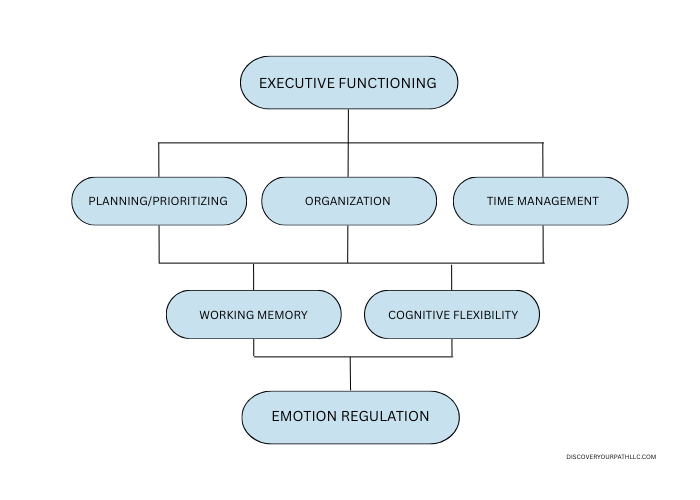
| Executive Functioning |
A Visual Map
| PLANNING & PRIORITIZING |
What it is: The ability to map out steps, see the bigger picture, and decide what matters most.
When working well:
⟡ Breaking a large task into smaller steps
⟡ Choosing what needs to happen first
⟡ Setting realistic timelines
Common challenges:
⟡ Feeling overwhelmed by where to start
⟡ Spending time on low-priority tasks
⟡ Underestimating how long things take
| ORGANIZATION |
What it is: Creating and maintaining systems that keep information and materials in order.
When working well:
⟡ Knowing where things are
⟡ Using planners, calendars, or routines
⟡ Sorting information effectively
Common challenges:
⟡ Clutter buildup
⟡ Losing important items
⟡ Feeling scattered with too many systems
| TIME MANAGEMENT |
What it is: Understanding and using time effectively.
When working well:
⟡ Accurately estimating how long tasks take
⟡ Shifting between tasks smoothly
⟡ Meeting deadlines consistently
Common challenges:
⟡ Running late
⟡ Losing track of time
⟡ Switching tasks too often or not enough
| WORKING MEMORY |
What it is: Holding information in mind long enough to use it.
When working well:
⟡ Remembering multi-step directions
⟡ Tracking what’s been done and what’s next
⟡ Doing mental math, reasoning, or planning
Common challenges:
⟡ Forgetting what you were about to do
⟡ Re-reading the same information
⟡ Needing frequent reminders
| COGNITIVE FLEXIBILITY |
What it is: Being able to shift perspectives, adapt, and pivot when plans change.
When working well:
⟡ Finding alternate solutions
⟡ Transitioning smoothly
⟡ Handling unexpected changes
Common challenges:
⟡ Feeling stuck on one way of doing things
⟡ Becoming overwhelmed by changes
⟡ Difficulty transitioning between tasks
| EMOTIONAL & BEHAVIORAL REGULATION |
What it is: Managing internal emotional responses and external actions.
When working well:
⟡ Pausing before reacting
⟡ Handling frustration in healthy ways
⟡ Staying grounded in stressful situations
Common challenges:
⟡ Feeling easily overwhelmed
⟡ Emotional outbursts or shutdowns
⟡ Impulse-driven decisions
Starting at the bottom, the emotion and behavioral regulation dictates the entire system and it’s functioning. The working memory and cognitive flexibility support the core actions: planning/prioritizing, organization, and time management. Thus, emotion regulation needs to be stable to allow for the working memory and cognitive flexibility to have a strong foundation to support the core actions. If the core actions have a strong foundation and support, they are able to be effective and efficient, creating healthy executive functioning.
Executive functioning isn’t about motivation or willpower, it’s a set of brain-based skills that vary from person to person. Many people with ADHD, trauma histories, anxiety, and chronic stress experience executive functioning difficulties. Understanding this helps reduce shame and encourages supportive tools, not self-criticism.