Understanding Personality Disorder Clusters
Personality disorders are often misunderstood and heavily stigmatized. They represent long-standing patterns of thinking, feeling, and relating to others that can cause distress or difficulty functioning. To help clinicians better understand and diagnose these patterns, personality disorders are grouped into 3 clusters based on shared traits and behaviors. These clusters are outlined in the Diagnostic and Statistical Manual of Mental Disorder (DSM-5-TR) and serves as an organizational framework.
Defining each of the clusters allows for increased clarity when working with personality disorders, as well as helping those living with personality disorders to better understand themselves. Understanding the clusters of personality disorders helps reduce stigma and increase compassion.
With increased awareness, education, and evidence‑based treatment, individuals with personality disorders can build healthier relationships, improve emotional regulation, and experience a greater sense of stability and self‑understanding.
Why Are Personality Disorders Categorized Into Clusters?
Clustering personality disorders helps mental health professionals:
Identify shared behavioral and emotional patterns
Improve diagnostic clarity
Guide treatment planning
Reduce overlap and confusion among diagnoses
Rather than viewing each personality disorder as entirely separate, clusters acknowledge that many disorders share core themes, such as emotional intensity, interpersonal difficulties, or fear‑based thinking.
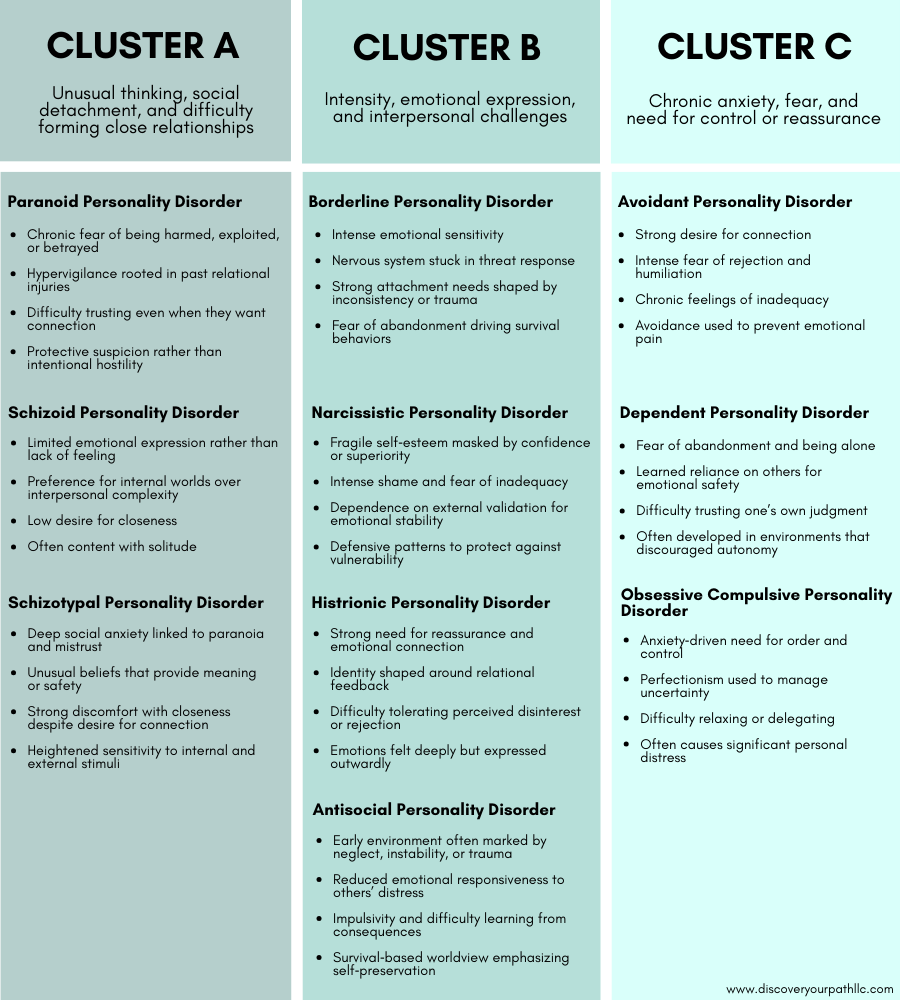
Cluster A
Characteristics:
🔘 Social detachment or limited desire for close relationships
🔘 Mistrust or suspicion of others’ motives
🔘 Unconventional thinking, beliefs, or perceptual experiences
🔘 Restricted emotional expression or interpersonal engagement
Lived Experiences:
🔘 Experience the world as intrusive, overwhelming, or unsafe
🔘 Relationships may feel draining, unpredictable, or risky rather than comforting
🔘 Feel most regulated when alone
🔘 Rely heavily on internal worlds, routines, or belief systems to create meaning and stability
Coping mechanisms:
🔘 Emotional and relational distance to reduce vulnerability
🔘 Heightened vigilance to anticipate potential threats
🔘 Intellectualization or reliance on internal logic systems
🔘 Preference for solitude, structure, or familiar environments
These patterns are not typically driven by a desire for attention or validation, but rather by a need for self-protection and internal stability. Relationships may feel confusing, threatening, or simply unnecessary, and solitude can feel safer or more manageable than closeness.
From a developmental perspective, Cluster A traits are often linked to early experiences of inconsistency, emotional neglect, or environments where trust was repeatedly violated. Over time, distancing or unusual belief systems can become reliable ways to make sense of the world and reduce distress.
Cluster B
Characteristics:
🔘 Intense and rapidly shifting emotions
🔘 Impulsivity or difficulty delaying reactions
🔘 Unstable sense of self or identity
🔘 Turbulent interpersonal relationships
Lived Experiences:
🔘 Experience emotions as overwhelming and all‑consuming
🔘 Relationships may feel essential for survival rather than optional
🔘 Feel deeply misunderstood, easily abandoned, or internally empty
Coping Mechanisms:
🔘 Strong emotional expression to signal distress or need
🔘 Action‑oriented responses (impulsivity, control, withdrawal)
🔘 Seeking validation or reassurance through relationships
🔘 Defensive self‑presentation to protect against shame or rejection
Cluster C
Characteristics:
🔘 High baseline anxiety and self‑doubt
🔘 Avoidance of perceived risk or criticism
🔘 Excessive reliance on others or rigid self‑standards
🔘 Difficulty tolerating uncertainty or autonomy
Lived Experiences:
🔘 Want closeness and success but feel held back by fear
🔘 Persistent sense of inadequacy or worry about making mistakes
🔘 Self‑critical, or afraid of disappointing others, when outwardly appearing responsible, compliant, or high‑functioning
Coping Mechanisms:
🔘 Avoidance of situations that could trigger rejection or failure
🔘 Perfectionism and over‑control to prevent mistakes
🔘 Seeking reassurance or guidance from others
🔘 Compliance or self‑sacrifice to maintain connection
Important Notes About Personality Disorders
Personality disorders exist on a spectrum, meaning a person can have certain traits without meeting full diagnostic criteria. Many individuals experience features from more than one disorder or cluster, and these traits may fluctuate in intensity across different life stages or stressors. Diagnosis is not about fitting neatly into a category, but about understanding enduring patterns that cause distress or impairment over time.
It’s also important to recognize that personality disorders do not develop in isolation. Trauma, attachment disruptions, chronic invalidation, and early relational experiences often play a significant role in shaping these patterns. What may later be labeled as a personality disorder frequently began as an adaptive way to survive, cope, or stay connected in unsafe or unpredictable environments.
With appropriate, evidence‑based treatment, meaningful change is absolutely possible. Approaches such as dialectical behavior therapy (DBT), schema therapy, psychodynamic therapy, and trauma‑informed modalities can help individuals improve emotional regulation, build healthier relationships, and develop a more stable sense of self. A diagnosis is not an identity, it is a tool for understanding, compassion, and healing.
