10 Common Narcissistic Behaviors
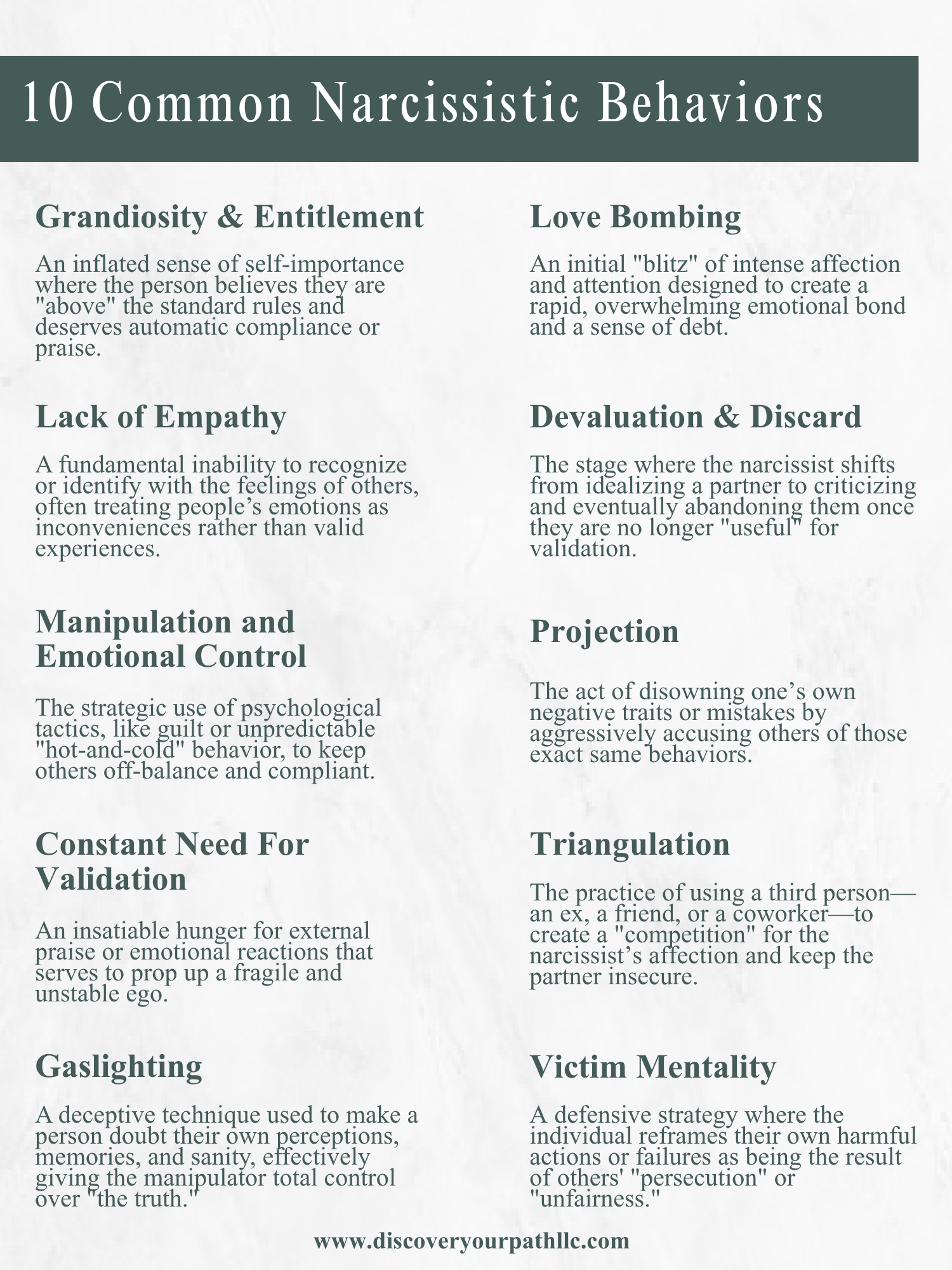
The term "narcissism" gets thrown around a lot, but there's an important difference between someone who occasionally seeks validation and someone with Narcissistic Personality Disorder (NPD). True NPD, as defined by the DSM-5, is a pervasive pattern of grandiosity, a deep need for admiration, and a marked lack of empathy for others.
Narcissistic traits exist on a spectrum. Many people exhibit some narcissistic behaviors without meeting the full clinical criteria. Understanding this spectrum is key to recognizing when a relationship has become genuinely harmful.
1. Grandiosity and Entitlement
Narcissists genuinely believe they are special, superior, and deserving of exceptional treatment. This isn't extreme self-confidence, it's an unshakeable belief that rules don't apply to them, that they deserve the best of everything, and that others exist to serve their needs.
Behaviors Present
Expecting preferential treatment at work
Becoming enraged when not receiving recognition
Bragging about accomplishments that are exaggerated
Steering any topic back to their own achievements, opinions, or experiences
2. Lack of Empathy
One of the most defining and damaging traits of narcissism is the inability, or unwillingness, to empathize. This doesn't mean narcissists never appear caring. They can be remarkably charming when it serves them. But when your needs conflict with theirs, their emotional vacancy becomes apparent.
Behaviors Present:
Mocking or minimizing other’s anxiety, depression, or grief
Giving "advice" that is really just criticism, framed as helping
Turning someone sharing their feelings into a discussion about own stress or difficulties
3. Manipulation and Emotional Control
Narcissists are often skilled emotional manipulators. They learn what makes you tick: your insecurities, your values, your need for approval, and use that knowledge strategically. Common manipulation tactics include guilt-tripping, intermittent reinforcement (hot-and-cold behavior), and playing the victim.
Behaviors Present:
Giving the silent treatment for days after a minor disagreement
Using other’s past mistakes or insecurities as ammunition during arguments
Creating urgency or crises to pull attention away whenever you start focusing on your own needs or goals
Flipping between being warm and cold with no warning, keeping you in a constant state of anxiety about where you stand
Reframing their controlling behavior as love or concern
4. Constant Need for Validation (Narcissistic Supply)
Psychologists use the term "narcissistic supply" to describe the attention, admiration, and emotional reactions that narcissists feed on. This supply is their lifeblood. Without it, they become destabilized, irritable, or depressed. Their relationships are often structured around ensuring a steady flow of this supply, which means the people around them must constantly perform appreciation and admiration.
Behaviors Present:
Posting constantly on social media and obsessively checking likes, reacting with disproportionate distress if a post underperforms
Fishing for compliments repeatedly about the same accomplishment
Getting into arguments or provoking conflict just to feel the intensity of your emotional reaction
Requiring constant reassurance about their attractiveness, intelligence, or importance in the relationship
5. Gaslighting
Gaslighting is a form of psychological manipulation in which the narcissist causes you to question your own memory, perception, or sanity. Phrases like "That never happened," "You're too sensitive," or "You're imagining things" are hallmarks of gaslighting. Over time, this erodes your confidence in your own reality.
Behaviors Present:
Dismissing or denying things that have been said or done
Rewriting the story of an event, discussion, or relationship
Convince others of their version of events to further make you question what really happened
6. Love Bombing
Love bombing is the intense, overwhelming affection that narcissists use at the beginning of a relationship to hook their target. Constant compliments, lavish gifts, declarations of soulmate, it feels like a fairy tale. That's by design. This phase creates a powerful emotional bond that makes it harder to leave when the inevitable devaluation begins.
Behaviors Present:
Texting or calling dozens of times a day in the first weeks, making you feel like the center of their universe
Wanting to spend every waking moment with you and framing any desire for space on your part as a rejection
Writing long, poetic messages about how you've "changed their life" and how they've never felt this way before
Introducing you to their family and friends almost immediately, fast-tracking a sense of deep commitment and enmeshment
7. Devaluation and Discard
After the love bombing phase, narcissistic relationships typically shift into devaluation. The same person who once put you on a pedestal begins to criticize, demean, and undermine you. Eventually, many narcissists will "discard" a partner entirely when the supply runs dry, only to potentially return when they need something again.
Behaviors Present:
They begin comparing you unfavorably to others, including exes
They become increasingly withdrawn, withholding affection or intimacy as a form of punishment
Your opinions, taste, or judgment are consistently ridiculed, often disguised as "just joking."
8. Projection
Narcissists frequently accuse others of the very behaviors they themselves are guilty of. If they are lying, they accuse you of lying. If they are cheating, they accuse you of infidelity. This projection serves two purposes: it deflects attention from their own behavior and keeps you on the defensive.
Behaviors Present:
Claiming others are always lying, even when caught in deception
Accusing others of being angry, right after they screamed at the person
Saying someone is selfish while in the same conversation asking that person to do something for them
9. Triangulation
Triangulation involves bringing a third party into the relationship dynamic to create jealousy, insecurity, or competition. This might mean talking up an ex, mentioning how someone at work is interested in them, or comparing you unfavorably to others. The goal is to keep you anxious and working hard to "win" their affection.
Behaviors Present:
Staying in close contact with an ex and insisting it's "not a big deal" when you express discomfort
Turning family members or mutual friends against you by sharing a distorted version of a conflict
Bringing a third person into arguments: "Even [friend's name] agrees you were wrong"
10. Victim Mentality
Despite their grandiose self-image, narcissists often position themselves as perpetual victims. Every conflict is someone else's fault. Every consequence of their behavior is an injustice done to them. This victim narrative serves to garner sympathy, deflect accountability, and maintain control.
Behaviors Present:
Describing every past relationship as ending because the other person was abusive, unstable, or "crazy."
Using their difficult childhood or past trauma as a permanent excuse for current harmful behavior, with no intention of working on it
Catastrophizing minor inconveniences as persecution: a delayed promotion becomes "They've always had it out for me."
Ultimately, identifying these behaviors is less about labeling a person and more about recognizing a toxic dynamic, whether it occurs with a partner, a parent, or a supervisor. When these traits become a rigid "operating system," the environment inevitably becomes a one-way street where your needs and reality are systematically sidelined. Gaining this clarity allows you to stop second-guessing your own perceptions and start implementing the boundaries necessary to protect your integrity and peace of mind.
